Compliant Mechanisms
A compliant mechanism is a mechanical device that transmits force and motion through the elastic deformation of its body, rather than through rigid links connected by joints. Instead of hinges, pins, and bearings, a compliant mechanism uses strategically thin or curved regions of material that flex under load. The entire mechanism is typically a single monolithic part — no assembly required.
Why It Matters
Conventional mechanisms — linkages, gears, cams — have served engineering well for centuries. But they come with inherent limitations:
- Assembly complexity: each joint is a separate part that must be manufactured, aligned, and fastened
- Wear and backlash: moving joints degrade over time and introduce play
- Lubrication: friction at joints requires ongoing maintenance
- Part count: a simple four-bar linkage needs at least 7 components (4 links + 3 pins + ground)
- Miniaturization limits: below a certain scale, conventional joints become impractical to manufacture
Compliant mechanisms eliminate all of these issues by consolidating the entire mechanism into a single part. This makes them especially valuable in:
- Precision instruments — no backlash means repeatable, predictable motion
- MEMS devices — micro-scale mechanisms where joints are impossible
- Medical devices — fewer parts means easier sterilization and higher reliability
- Space hardware — no lubrication needed in vacuum environments
- Consumer products — reduced assembly cost and part count
Real-World Examples
Compliant mechanisms are more common than most engineers realize:
Everyday Objects
- Binder clips: a single piece of spring steel that grips through elastic deformation
- Snap-fit enclosures: the clips on a battery cover flex to lock in place
- Shampoo bottle caps: the flip-top lid is a living hinge — a thin polymer section that acts as a joint
- Clothespins: older wooden designs use a compliant spring mechanism
Engineering Applications
- MEMS accelerometers: the sensor in every smartphone uses a compliant flexure to measure acceleration
- Optical mounts: precision mirror mounts use flexure mechanisms for nanometer-resolution adjustment
- Heart valve prosthetics: compliant polymer valves mimic natural tissue behavior
- Satellite deployment mechanisms: one-shot compliant hinges unfold solar panels in orbit
- Thermal compensators: flexure mounts that accommodate thermal expansion without introducing stress
How They Work
The Flexibility-Stiffness Trade-off
Every compliant mechanism must balance two competing requirements:
- Stiff enough to transmit force from the input point to the output point without excessive loss
- Flexible enough to deform and produce the desired output motion
This trade-off is fundamental. A perfectly rigid structure transmits force efficiently but cannot deform. A perfectly flexible structure deforms freely but cannot transmit force. The art of compliant mechanism design is finding the material distribution that optimally balances these demands.
This is exactly the problem that the deFlex design engine solves. It explores the full space of possible material distributions to find the layout that maximizes output motion while maintaining adequate stiffness. See Design Optimization.
Load Path and Deformation
In a compliant mechanism, force follows a specific path through the structure:
- Input force is applied at the input preserve (e.g., a bolt pad connected to an actuator)
- Force transmits through the mechanism's structural members
- Thin flexure regions deform elastically, converting input force into output displacement
- Output motion occurs at the output preserve in the desired direction
- Fixed preserves provide the reaction forces that make the mechanism work — without fixed mounting points, the entire structure would simply translate rather than deform
The design engine discovers the optimal arrangement of thick (stiff) and thin (flexible) regions to create efficient load paths and amplify or redirect motion.
Mechanical Advantage
Like conventional mechanisms, compliant mechanisms can amplify or reduce force and displacement:
- Motion amplifiers: a small input displacement produces a larger output displacement (at reduced force)
- Force amplifiers: a large input displacement produces a smaller output displacement (at increased force)
- Motion redirectors: input motion in one direction produces output motion in a different direction
The mechanical advantage is determined by the topology — the arrangement of material within the design space. deFlex's optimizer naturally discovers the topology that achieves the desired input-output relationship.
How deFlex Designs Them
Problem Setup
In deFlex, you define a compliant mechanism design problem by specifying:
- Design space — the bounding region where material can be placed
- Input preserves — where force enters the mechanism, with a specified direction
- Output preserves — where desired motion occurs, with a specified direction
- Fixed preserves — anchored mounting points that provide reaction forces
- Pairs — which input preserves drive which output preserves, with stiffness coupling
- Volume fraction — how much of the design space can be filled with material
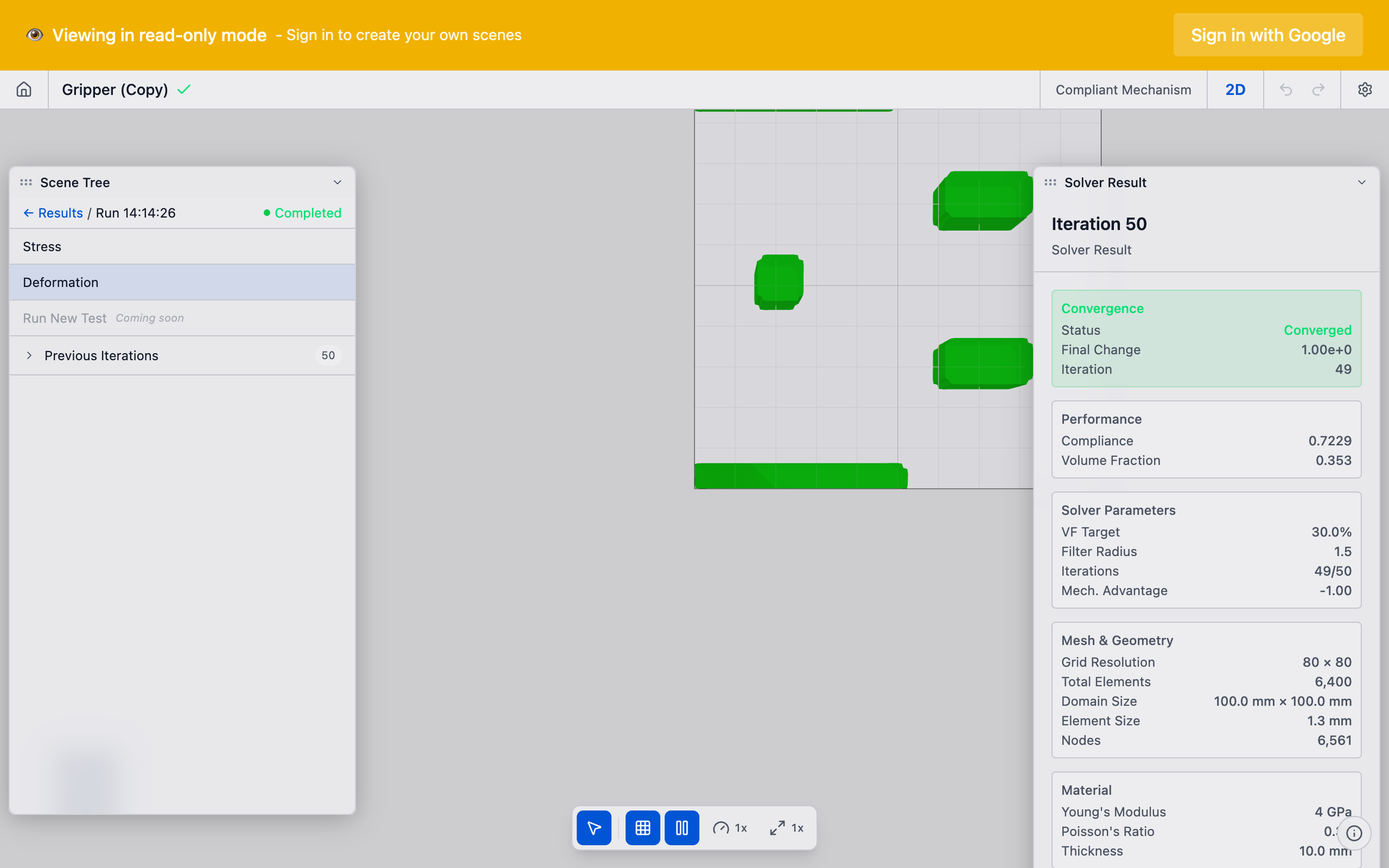
What the Solver Produces
The design engine outputs a density field — a value between 0 and 1 for each element in the mesh:
- 1 (solid): this region should contain material
- 0 (void): this region should be empty
- Intermediate values: transitional regions (a well-converged design minimizes these)
The density field directly represents the optimal compliant mechanism topology. Material is concentrated along load paths, with thin flexure regions at locations where the mechanism needs to bend.
When evaluating a result, look for clear load paths connecting your input preserves to your output preserves through the fixed mounting points. If the structure looks disconnected or has floating islands of material, the problem setup likely needs adjustment.
Design Considerations
When setting up a compliant mechanism problem in deFlex, keep these principles in mind:
- Preserve placement matters enormously: the relative positions of input, output, and fixed preserves largely determine what topologies are possible. Small changes in preserve location can produce dramatically different mechanisms.
- Direction vectors define the mechanism type: an input pushing right and an output moving up creates a 90-degree motion redirector. Parallel input/output directions with offset positions create amplifiers.
- Fixed preserves provide leverage: the mechanism needs something to push against. Place fixed preserves where they can provide effective reaction forces for the desired motion.
- Volume fraction controls complexity: lower volume fractions (0.2-0.3) produce elegant mechanisms with thin, well-defined flexures. Higher fractions (0.4-0.5) produce bulkier structures.
Nonlinear Analysis
deFlex supports nonlinear structural analysis for applications involving large deformations or nonlinear material behavior. When enabled, the solver can use the following material models:
- linear_plane_stress (default): standard linear elastic analysis, suitable for small deformations
- svk (Saint-Venant Kirchhoff): handles geometric nonlinearity (large rotations) with a simple constitutive law
- yeoh: a hyperelastic model suitable for rubber-like materials with large strains
- neo_hookean: a hyperelastic model commonly used for soft materials and large deformations
Nonlinear analysis is enabled through the analysis settings and allows deFlex to accurately capture the behavior of mechanisms that undergo significant deformation during operation.
Limitations
Compliant mechanisms are not appropriate for every application:
- Fatigue: repeated cycling through large deformations can cause fatigue failure
- Limited range of motion: elastic deformation is inherently small compared to rigid-body joints
- Energy storage: compliant mechanisms store elastic energy, which means they require continuous force to maintain a deformed position (no self-locking)
See Also
- Design Optimization — the AI-driven engine that designs the mechanism
- Preserves Overview — defining the input, output, and fixed regions
- Pairs — linking inputs to outputs with stiffness coupling
- Design Space — the region where the mechanism is generated
- Results Interpretation — reading the optimizer output